

Standing just a short distance from the iconic Transporter Bridge is one of Middlesbrough’s oldest surviving buildings. Today it is known simply as MyPlace, a modern youth centre serving the town’s young people. Yet behind its restored façade lies a remarkable history stretching back almost 190 years.
Long before it became MyPlace, or even the town’s Custom House, the elegant Greek Revival building was a bustling hotel, business exchange and eventually the headquarters of HM Customs and Excise. It has witnessed almost the entire history of modern Middlesbrough.
Built Before Middlesbrough Really Existed
One of the most remarkable things about the building is its age.
Designed by George (G.) Burlison of Darlington, construction began in 1836, only a few years after the new town of Middlesbrough had been laid out by the Owners of the Middlesbrough Estate. It officially opened in August 1837, making it one of the earliest substantial public buildings in the new settlement.
At the time, Middlesbrough was expanding at an astonishing pace. Coal from the Durham coalfield was arriving via the Stockton & Darlington Railway, while ships loaded at the new port exported it around Britain and overseas.
The town needed somewhere for merchants, shipowners and businessmen to meet.
Originally a Coal Exchange… and a Hotel

A sketch of the Customs House around 1840. From ‘The History Of Middlesbrough’ by William Lillie
Although most people know it as the Custom House, that wasn’t what it was built for.
Its original purpose was as a Coal Exchange, complete with public exchange rooms where merchants could conduct business, private offices and the Exchange Hotel, providing accommodation for visitors arriving to trade in the rapidly growing port. In many ways it was Middlesbrough’s first commercial headquarters.
Businessmen would negotiate cargoes, shipping contracts and coal prices while staying overnight under the same roof. As the young town expanded almost overnight, the building became one of its most important landmarks.
Architecturally, it reflected confidence in the future. Built in an elegant Greek Revival style, the two-storey building features sandstone ashlar on its principal elevations, giant pilasters, Doric columns and beautifully proportioned reception rooms that still survive today. Historic England awarded it Grade II listed status in 1972.
From Hotel to Town Hall
Unfortunately, the Coal Exchange venture proved less successful than its founders had hoped.
By 1853, the newly created Middlesbrough Borough Council purchased the building, only months after the town received its Charter of Incorporation from Queen Victoria.
For a time it effectively became the town’s first civic headquarters. Known as Corporation Hall, it housed the council chamber, magistrates’ rooms, offices for the Superintendent of Police and even several police cells where offenders could be held overnight.
It remained at the centre of civic life until the purpose-built Old Town Hall was opened nearby, allowing the council to relocate.
In fact, the Duke of Sussex (who was the uncle of Queen Victoria) dined here on October 29, 1838 during the first royal visit to Middlesbrough
Becoming Middlesbrough’s Custom House

The Customs House in the 1960s. Photo: Paul Stephenson.
In 1881, the building entered the role that would define it for the next century.
It was acquired by HM Customs and Excise, becoming Middlesbrough’s official Custom House.
This was a logical choice. By the late Victorian period, Middlesbrough had become one of Britain’s busiest industrial ports. Iron, steel, coal, chemicals and manufactured goods flowed through the docks, while ships arrived from around the world carrying imports.
Customs officers worked from the building, inspecting cargoes, collecting duties and overseeing international trade entering and leaving the port.
For generations of dock workers, ship captains and merchants, the Custom House became an essential part of daily business.
Decline Alongside Old St Hilda’s

A picture of the Customs House boarded up in October 1978 with a ‘For Disposal’ sign outside.
Like much of old Middlesbrough, the fortunes of the building changed dramatically after the Second World War.
As shipping patterns evolved and St Hilda’s underwent extensive redevelopment during the 1960s and 1970s, many of the surrounding Victorian streets disappeared beneath clearance programmes.
HM Customs eventually left the building around 1976, ending almost a century of official use.
For a while, it found a new purpose as a community and recreation centre after refurbishment in 1981, but as regeneration plans for Middlehaven developed, the future of the historic building became uncertain.
Many neighbouring historic buildings weren’t so fortunate. The nearby Royal Exchange was demolished, while large areas of St Hilda’s vanished completely.
Saved for a New Generation


The impressive rear of MyPlace today.
Fortunately, the Custom House survived.
In the late 2000s, the building underwent an extensive restoration as part of Middlesbrough Council’s £4.3 million MyPlace project, carefully combining the historic listed building with striking contemporary architecture.
The transformed centre officially opened on 30 June 2012 as MyPlace, providing facilities for young people including recording studios, performance spaces, meeting rooms, sports facilities and support services. More than 800 local young people were involved in shaping the project before it opened.
The project gave one of Middlesbrough’s oldest buildings a completely new lease of life while preserving its historic character.
One of Middlesbrough’s Oldest Survivors
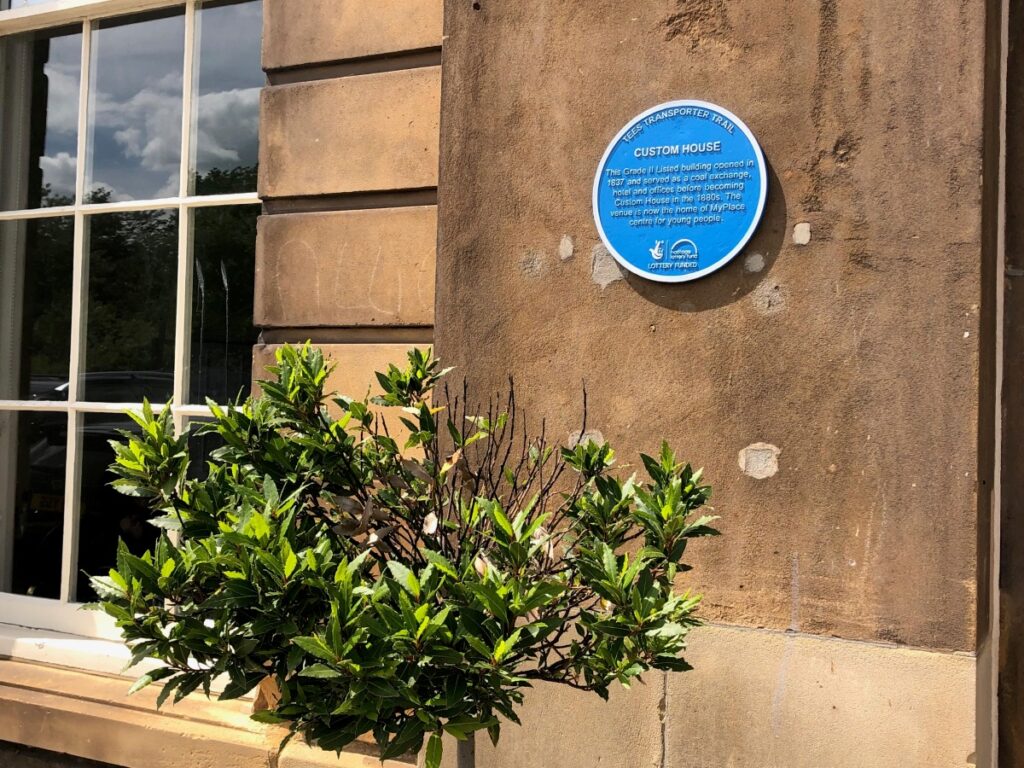
A plaque on the door of the Customs House comemorating its past.
Today, it’s easy to overlook the significance of the building, hidden in a quiet corner of Middlesbrough not much frequented any more. Yet few buildings in Middlesbrough can match its remarkable story.
It has been:
- A Coal Exchange
- A hotel
- Middlesbrough’s first Corporation Hall
- Police headquarters
- Magistrates’ court
- HM Customs and Excise headquarters
- A community centre
- And today, MyPlace.
Few buildings anywhere in Teesside have adapted so many times while remaining in continuous use for almost two centuries.
It tells the story of Middlesbrough itself.
What are your memories of Middlesbrough’s Customs House? Leave a comment below!